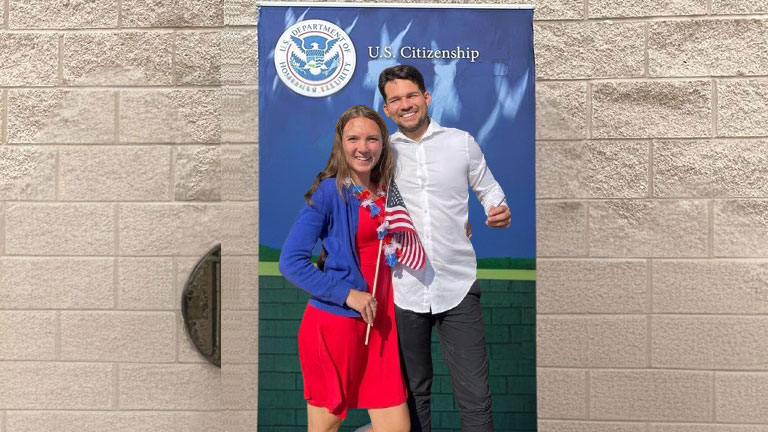
The path to U.S. citizenship offers both promise and challenges. Many people begin the process with enthusiasm, but soon they discover that the application involves documentation, extensive form-filling, and multiple levels of review. Data shows that by 2024, there will be over 26 million naturalized citizens in the U.S., representing approximately 51% of the foreign-born population. In fiscal year 2024 alone, 818,500 people were naturalized.
Hurdles to U.S. Citizenship: Key Challenges Every Applicant Must Know
This large number of new citizens indicates that many people want to move toward citizenship, but the lack of transparency in the process has led to confusion and questions. Applicants sometimes find it helpful to seek the assistance of an experienced immigration lawyer to understand their rights and responsibilities to avoid any confusion during the process.
The citizenship process requires a clear plan from the beginning. Every person’s journey is different, so we try to cover all the queries regarding citizenship in the USA.
Who can apply for citizenship in the United States?
Applicants must meet certain basic qualifications to obtain U.S. citizenship. First, you must live in the United States as a permanent resident (green card holder). Most applicants for citizenship are required to reside in the United States continuously for at least five years after receiving their green card. You must be physically present in the United States for at least half of these five years, or approximately 30 months. If you are married to a U.S. citizen, this period increases to three years, and you must spend at least 18 months in the United States during this period.
Furthermore, the minimum age for citizenship is 18 years old. If you are younger than this age, you cannot automatically claim citizenship (in many cases, children become citizens when their parents become citizens). You must demonstrate a desire to permanently accept the basic legal requirements and principles of freedom in the United States. In short, to become a U.S. citizen, you, like millions of immigrants, complete five years as a green card holder (or three if married) and complete the remaining citizenship application formalities.
Having documents isn’t enough for citizenship; you also need to properly meet all the requirements. Understanding these eligibility requirements and preparing your application can make the process easier.
Can your criminal record be a barrier to citizenship?
The citizenship process also assesses your behavior and character. A person seeking citizenship must demonstrate “good character.” USCIS (Immigration Service) policy lists certain crimes that may prevent proof of good character. That is, a criminal record can pose a problem on your path to citizenship, but not every minor offense is automatically considered a violation. Serious offenses, such as those punishable by five years or more in prison, or those involving repeated violations of the law, can directly impede citizenship. Minor offenses (such as traffic violations) are often expungable, but they must also be fully disclosed in the application.
All information provided on the application must be truthful. Concealing or providing false information about a past offense can significantly hinder the assessment of your “good character.” Therefore, it is always advisable to honestly present your criminal history, regardless of its length. In more complex cases, you may want to consult an immigration lawyer or expert to determine how your history may impact your citizenship application.
Language Challenges
A major challenge for most applicants to obtain citizenship is the English language test. According to USCIS regulations, you must demonstrate basic reading, writing, and speaking English. This means you must be able to read and write simple sentences fluently and respond to conversations in English during the interview. The interviewing officer will ask you some common questions, and you must respond in English.
However, there are some exceptions: For example, if you are over 50 or 65 years old and have registered permanent residence in the United States for a long period (20 or 15 years), you may be exempt from the English test. In these cases, you can also take the civics test in your native language, and the English test may have specific modifications. Everyone else must take the general English test.
Many applicants seek help from community classes or study groups to prepare for English. You remember that the citizenship English test isn’t overly complicated. It covers simple sentences, everyday words, and basic expressions. If you struggle with English at first, a little practice can help you build confidence. There are many free resources available online and practice materials on government websites, allowing you to prepare in advance.
Residency Requirements for Citizenship
A key requirement for citizenship is continuous residency. You must have lived in the United States for five consecutive years (or three years if married). Your physical presence in the United States also counts: you must have been physically present in the United States for at least 30 months of these five years. This means you need to be careful if you travel abroad for extended periods between these periods.
Be especially aware that a single trip abroad for more than six months may challenge your continuous residency status. In such a situation, USCIS may assume that you did not reside in the United States temporarily, and you may need to provide an explanation. If you leave the United States for more than six months, you will need to prove again that you maintained your life in the USA.
More importantly, if you stay abroad for a year or more, your continuity is generally completely broken. In such a situation, you may have to complete a minimum of five (or three) years for your citizenship application again, and the calculation may begin again from the date you return to India. For example, if you went abroad for a year in 2020 and returned in 2021, you would need to reside in the United States until December 2025, or approximately five more years, to cover your previous absence.
It is therefore important to keep a record of your travel dates and avoid prolonged absences from the United States. If travel becomes necessary, keep proof of every step, such as visa stamps, boarding passes, leave papers, etc., so that you can prove your intention to return to the United States in case of any questions. Having documentation of your continued residence in this way can make the citizenship application easier, rather than a major hurdle.
What does the Civics Test involve?
The citizenship process includes an interview, in which information from your completed application and your background is examined. During this interview, you will also be required to take a Civics Test. This test addresses the fundamental principles of American history, government, and citizenship.
Questions may include questions about the fundamental principles of the United States Constitution, the three branches of government, historical events such as the War of Independence, and facts about national symbols (such as the American flag, the national anthem). For example, questions might include, “What is the supreme law of the Constitution?” “What is the amendment process to the Constitution?” “When was the United States declared independent?” “What are the fundamental rights of citizens?”, etc.
Most questions are taken from a list of 100 questions available on the official USCIS website. During the interview, the officer selects a few of these 100 (current rules allow a maximum of 20 questions), and you must answer six or more of them correctly. Although the questions are basic and not as comprehensive as the Indian curriculum, preparation builds confidence. You can practice by reading the answers to these questions at home and using an English-Hindi guide or a free online test helper.
Hopefully, the Civics test won’t be a major challenge if you’ve prepared in advance. Having learned the basics of American history and government beforehand will make the interview experience more like a conversation. Passing both the English and civics tests is essential to becoming a citizen, so taking the time to prepare will make the path to future citizenship easier. Millions of professionals, truck drivers, labour workers, and students are looking for permanent residence and citizenship in the USA.
The citizenship process involves the following challenges: meeting the eligibility criteria, demonstrating good character, passing the English and citizenship tests, and meeting the required residency requirements. Preparation and proper documentation will help you achieve your goal. The process is lengthy and complex, but with hard work, honesty, and preparation, you can overcome these obstacles and fulfill your dream of becoming a U.S. citizen. Each applicant’s path may be different, but patient planning will ensure you reach your goal.