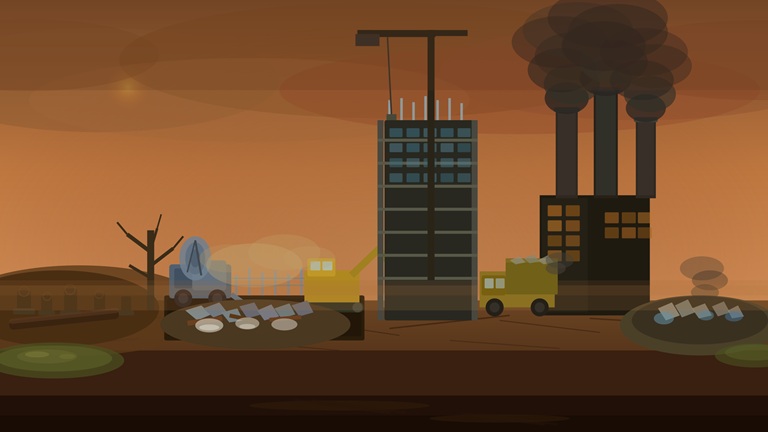
The home and building construction is clearly a major source of global greenhouse gas (GHG) emissions. In 2022, it caused about 40% of global CO₂ emissions from fuel burning and 25% of total GHG emissions. This effect comes from the full life cycle of buildings and infrastructure, including planning, construction, material production, use, and demolition. In the European Union, building construction alone uses 40% of materials and 40% of primary energy, while creating 40% of waste each year.
Across the world, the construction sector produces an estimated two billion tons of construction and demolition waste every year, which is about one-third of all global waste. Sadly, only a small part of this waste is recycled or reused now, while most of it goes to landfills or is burned. This one-way system uses up natural resources and adds to GHG emissions not only from making new materials, but also from landfill gases and uncontrolled burning.
The Hidden Environmental Cost of Traditional Construction
Traditional construction depends heavily on materials like wood, concrete, and cement. These may seem ordinary, but when you look closely, they have a much larger environmental impact than many people expect.
Cement production releases very large amounts of CO₂. It needs limestone to be heated to extremely high temperatures, uses fossil fuels, and releases carbon stored in the stone itself. In the U.S., demolition alone created over 500 million tons of waste, including wood, concrete, drywall, and more. This also highlights the importance of better planning and structural safety checks, where reliable seismic testing services can help ensure buildings are strong, reduce future damage, and avoid unnecessary reconstruction waste.
Traditional buildings also carry what experts call “embodied carbon.” This includes all emissions from raw material extraction, manufacturing, construction, transport, and even demolition. A 2024 study found that embodied carbon makes up about 84% of total construction emissions for a typical building.
Air Pollution, Dust, and Health Risks
Construction work is a major cause of poor air quality. The sector is responsible for nearly 39% of energy-related and process-related CO₂ emissions, mostly because of material production like cement and steel, machine use, and transport.
One often ignored, but very important problem is dust release. Construction creates large amounts of particulate matter (PM10 and PM2.5) from materials such as concrete, cement, sand, and stone. These tiny dust particles can stay in the air for a long time and move far away, causing wide environmental and health effects. Fine particles can settle on plants, pollute water through runoff, harm photosynthesis, and reduce soil quality.
Construction sites are also major sources of air pollution. A key overlooked source is dust that sticks to vehicles leaving the site and then gets stirred up again on public roads, staying in the air for days or even weeks. Health problems linked to construction pollution include breathing illnesses such as bronchitis, asthma, and lung infections, lung cancer from long-term PM exposure, heart and blood vessel disease, and a higher risk of death.
GHG Emissions from Machinery and Non-Renewable Resources
Construction machines are a major source of greenhouse gas (GHG) emissions on-site. Diesel machines such as loaders, excavators, cranes, and generators release large amounts of carbon dioxide (CO₂), nitrogen oxides (NOₓ), and particulate matter into the air. Most equipment runs for long hours without the best emission control, which makes the construction sector one of the biggest industrial sources of local air pollution.
The industry’s dependence on non-renewable resources is very high. Construction alone uses half of all non-renewable resources consumed around the world, and concrete is the second most used material after water. The cement companies alone are responsible for 8% of worldwide CO₂ emissions. Sand and gravel mining can also cause serious environmental damage, including destruction of habitats and water pollution.
The Rework Multiplier Effect
Rework is more than a normal part of construction; it is a widespread problem that strongly slows project success. Its direct cost can range from 0.5% to more than 20% of the total contract value. This financial pressure becomes even worse because rework also harms the project’s cost, schedule, and quality. Every time work has to be done again, it adds more waste, more energy use, and more carbon emissions in the construction sector.
On-site construction work also adds heavily to carbon emissions, with reinforced concrete work making up 23.9% of total CO₂ emissions during the on-site construction stage. In addition, electricity used for concrete work on site accounts for 41.9% of total electricity used during construction. Any work that requires concrete to be redone directly increases both energy use and emissions.
The Path Forward
The building and construction industry faces a major challenge, with 90% of construction company emissions counted as scope 3 – emissions from materials and transport, mostly outside a company’s direct control but still within its influence. Using electric equipment, cleaner fuels, and better maintenance can help lower the carbon footprint of construction work. Methods that reduce rework, along with digital tools in the construction process, can cut material waste by 23–100%.