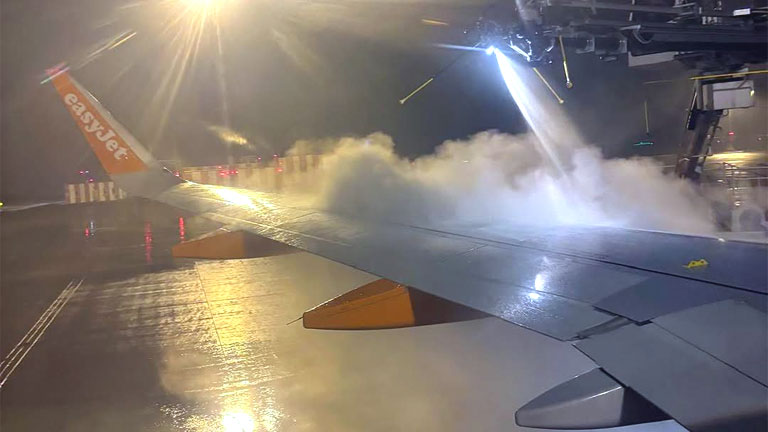
Choosing the correct deicing fluid based on temperature and aircraft type is essential to remove ice effectively and avoid damage to aircraft paint and surfaces.
Proper disposal of used fluids and related environmental concerns also adds complexity to the process.
Deicing fluids are vital for keeping aircraft, runways, roads, and equipment free of ice during severe winter weather, helping ensure safer and more efficient operations.
Why Ice Formation Is Dangerous
Ice does not just stay on an aircraft’s surface without causing problems. It greatly affects how the aircraft flies. According to the International Civil Aviation Organisation, ice on the wings can reduce lift by up to 30% and increase drag by as much as 40%.
This can be extremely dangerous during takeoff.
Tests by NASA’s Glenn Research Centre found that even 2 minutes of exposure to clear ice can double the drag, reduce the maximum lift by 25–30%, and lower the critical angle of attack by 8 degrees. This leads to a much higher stall speed.
When ice builds up on airplane wings & control surfaces, various risks occur:
- Disrupted airflow: Even a very thin layer (about 0.4 mm) can strongly affect drag, lift, and handling.
Increased weight: Built-up ice adds extra load that the engine must push. - Changed wing shape: Ice alters the front edge of the wing, reducing aerodynamic performance.
Reduced control response: Frozen material on control surfaces limits maneuverability.
The aircraft surface temperature is often more important than the outside air temperature. Ice forms because very cold fuel inside the wing tanks cools the surface, causing moisture to condense and freeze. Ground icing can happen even when the air is above freezing through a process called “cold soaking.”
Anti-Icing vs Deicing Methods
These terms are not the same. They describe different actions with different goals.
Deicing removes snow, ice, and frozen material that is already on the aircraft.
Anti-icing stops ice from forming again after deicing is finished.
Deicing fluid cleans the surface, while anti-icing fluid creates protection so freezing does not return. The process is done in one of two ways:
- One-step process: A single spray of heated anti-icing fluid removes the ice and prevents it from freezing again. This method is commonly used in Europe.
- Two-step process: First, heated Type I fluid is used to remove the ice. Then, Type IV anti-icing fluid is applied to protect the surface. This two-step method is more common in North America.
Airports often choose the two-step method because it works better in harsh weather, such as active snowfall or rain. Ground teams check air temperature, type of precipitation, and time before takeoff to decide which method to use.
Types of Deicing Fluids
Not all deicing fluids are identical. SAE International defines four aviation fluid types: Type I, II, III, and IV.
Type I fluids are the thinnest. They can be used on any aircraft because they flow off easily, even at low speeds. They are mainly used to remove ice.
Main ingredient: Propylene glycol or ethylene glycol
Application: Sprayed hot (130–180°F / 54–82°C) at high pressure to remove snow, ice, and frost
Holdover time: Shortest — usually 1 to 22 minutes, depending on the weather
Type II fluids are thicker and contain special polymers that help them stay on the surface longer.
Type IV fluids are similar to Type II but provide much longer protection. They are widely used for commercial aircraft in North America.
All these fluids work by lowering the freezing point of water. The main chemicals – propylene glycol or ethylene glycol, and in some applications, potassium acetate liquid deicer – make it harder for water to freeze.
Lower Operational Use Temperature (LOUT) defines the coldest temperature at which a fluid still works properly. It is the lowest temperature at which the fluid can flow off key aircraft surfaces and still provide enough anti-icing protection.
Insights on Fluid Types, Technologies, Equipment, and Application Use
Operational analysis helps decision-makers understand trade-offs when choosing fluids, technologies, and equipment. Each fluid type – Type I through IV – is designed for specific uses, protection times, and environmental handling needs, meaning each has advantages in certain situations.
Fluid selection is closely linked to technology choice. Chemical deicing is still the main method for many operators, while infrared heating and advanced spray systems are developing as supporting methods that can reduce chemical use under certain conditions.
Equipment also plays an important role. Deicing trucks allow precise application for large aircraft and fast turnaround times. Sweepers help clear surfaces and manage contamination on aprons and taxiways.
These factors must be considered together. Fluid type, technology, equipment, and application all depend on one another and must be chosen as part of a complete strategy.
Significant Market Challenges
The industry continues to change because of issues related to performance, supply, and environmental impact of deicing fluids. Severe weather can affect safety and delay flights, especially when fluid performance varies by condition.
Supply chain problems – especially in colder, high-demand regions – can lead to shortages and delivery delays. Costs also rise because fluids require temperature-controlled storage and specialized equipment.
Environmental rules are pushing the industry toward more eco-friendly alternatives, though some newer options are still being tested.