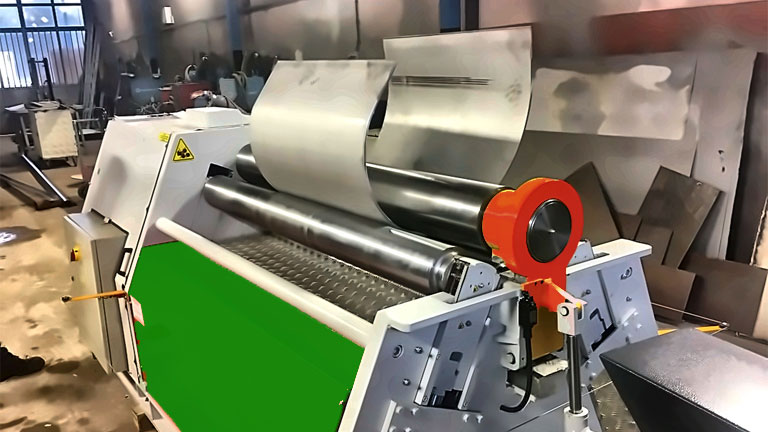
The fabrication industry has seen a major change in recent years. In the past, workshops depended on manual tools and uneven working methods. Today, modern machines bring better accuracy, faster speed, and improved efficiency. Among these developments, plate rolling technology has become very important for metal fabrication workshops. With modern automation, CNC control, and strong hydraulic systems, plate rolling machines help manufacturers create smooth curves, high-precision parts, and faster production.
What Is Plate Rolling?
Plate rolling is the process of shaping and bending metal sheets. It can bend to curved shapes, cylinders, or cones using a set of rollers. In earlier times, plate rolling required manual adjustments and several passes to get the correct shape. Modern machines now use hydraulic power, CNC control, and advanced rollers. You can bend thick metal plates with high accuracy.
How Plate Rolling Improves Productivity in Fabrication Workflows
One of the main benefits of modern plate rolling machines is CNC automation. CNC systems allow workshops to enter exact bending settings, which saves time and increases accuracy.
Automated features include:
- Pre-programmed bending steps
- Automatic roller positioning
- Real-time thickness adjustment
- Consistent and repeatable results
When these machines are used together with other CNC-controlled equipment, such as a CNC press brake machine and a CNC hydraulic shearing machine, the full workflow becomes faster and more efficient.
Types of Plate Rolling Machines
Three-Roll Plate Rolling Machines
The three-roll plate rolling machine is the most common setup used in metal fabrication shops. These machines have two bottom rollers that move the metal sheet and one top roller that provides bending pressure. This pyramid arrangement allows operators to adjust the top roller to control the bending curve.
Four-Roll Plate Rolling Machines
Four-roll machines include an additional roller that helps remove or greatly reduce flat edges that usually appear in three-roll machines. The four-roll plate rolling machine uses separate bottom rollers that move up and down, allowing full pre-bending of sheet edges. This feature produces almost perfect cylinders without the need for extra edge-bending work.
Mechanical vs. Hydraulic Systems
Plate rolling machines use either mechanical or hydraulic systems to create a bending force.
Mechanical systems use electric motors, gear systems, and screw mechanisms to move the rollers. These systems offer good repeatability and usually need less maintenance.
Hydraulic plate rolling machines use pressurized fluid to move cylinders that control roller position and bending pressure. Hydraulic systems provide smoother operation and more precise pressure control, which is useful when working with delicate materials or when high accuracy is required.
Key Features of Modern Plate Rolling Machines
Numerical Control Integration
Modern plate rolling machine manufacturers offer machines with NC (Numerical Control) or CNC systems that automate bending work. Operators enter details such as material thickness, strength, required radius, and sheet size. The control system then calculates the best roller positions and automatically performs the bending steps.
Pre-Bending Capabilities
Pre-bending is an important feature that separates basic rolling machines from advanced systems. It reduces or removes flat sections at the sheet edges by shaping these areas before the main rolling process begins. Double pre-pinch systems found in high-quality plate rolling machines can pre-bend both edges in one setup, which improves productivity.
Applications Across Industries
Construction and Infrastructure
Steel fabrication companies create curved beams, columns, and design elements that are used in modern building structures.
Energy Sector
Wind turbine towers are made from several rolled sections that are welded together to create tall conical towers that can exceed 100 meters in height.
Shipbuilding and Marine Industry
Ship construction requires large amounts of plate rolling for building hulls, deck structures, and internal partitions.
Factors Affecting Sheet Rolling Machine Price
Machine Capacity and Configuration
The price of a sheet rolling machine mainly depends on its bending capacity, which includes the maximum plate thickness and working width it can handle. Machines that process thicker materials require stronger frames, larger rollers, and more powerful drive systems, which increases their cost.
Control System Complexity
Manual plate rolling machines are the most affordable option, but require experienced operators. Adding numerical control systems increases the price but improves automation, programming ability, and consistent results.
Operating and Maintaining Plate Rolling Equipment
Operator Training Requirements
Proper operation of a plate rolling machine requires knowledge of material behavior, machine capability, and safety rules. Training programs usually include machine setup, parameter selection, quality checking, and problem solving.
Preventive Maintenance
Regular maintenance helps maintain machine performance and increases equipment life. Daily maintenance usually includes cleaning, checking lubrication, and visual inspection of machine parts.
Common Troubleshooting Issues
An uneven bending curve may occur due to roller alignment problems or uneven pressure. Marks on the metal surface may appear if there is too much pressure, dirty rollers, or poor lubrication.