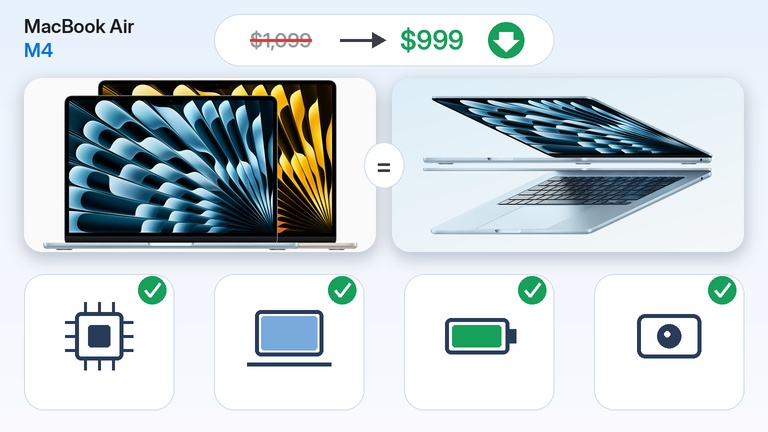
Apple launched the M4-series MacBook Air M4 (13-inch and 15-inch) on March 5, 2025. No, Apple launched the M4 MacBook Air models at a $100 lower starting price than the previous M3 versions. Key upgrades these MacBooks received are: powered by the M4 chip with a baseline of 16GB unified memory, added Thunderbolt 4 ports (upgraded from Thunderbolt 3), and support for dual 6K external displays. It also has a 12MP Center Stage webcam and a new sky blue color option.
But Apple did all this without increasing the price. How did they do it? Let’s learn about it.
1. Lower M4 chip manufacturing costs
M4 costs less to manufacture than M3. The yield for M3 was pretty low. But with refinements to the process used. They can now achieve better yields. However, this might not result in parts getting $100 cheaper. I think the switch to M4 might be the biggest cost saver for Apple. But nowadays, chip costs have increased; that’s why most laptop prices have increased at Apple
2. Reusing the existing design and components
It is the same chassis as the M2 MacBook Air. Same display. Same keyboard. Just different M-series chips. Overall bill of materials went down a lot for these components over the last few years.
Also, the MacBook Air used to be a $999 price point forever.
3. Economies of scale and mature supply chains
Economies of scale and mature supply chains. They have made and sold so many Airs to the point where it is now efficient enough to be feasibly sold at a competitive price with newer releases.
It’s essentially just a new chip in a 3+ year old body.
4. The appeal of a $999 starting price
Basically this: $999 seems way less expensive than $1099 from a psychological price point.
I would imagine they have always had some price flexibility, and their decision was probably made in consideration of current economic realities that people are being budget-conscious. I would also imagine that if rumors are true. It is cheaper to manufacture the M4 than the prior-gen M3, which could have yielded some savings in addition to other component savings as well.
5. Moving buyers to the latest model
Presumably they wanted to get people buying the new MacBooks instead of the M2 or M3 being kept as the budget model. I think they would much rather have you on the latest tech than buying old tech from them. Even if that means a slightly smaller profit margin, though obviously the profit margins on Apple products are insane already.
The Air started already at $999 with the M2; Apple removed the M2 and M3, so the M4 took the same starting price spot. As simple as that.
Clarification of the M2 price:
I am talking about the M2 when the M3 was already out
6. Growing competition from other laptops
Competition is picking up, especially with the new Snapdragon Elite laptops; Apple needs its base laptops to remain competitive. Battery life used to be a special feature for the MacBooks, but not anymore; performance-wise, also, the competition is catching up.
7. Revenue beyond the initial laptop purchase
Apple is looking at the big picture here; they are not idiots. They are looking at the MacBook like a console manufacturer. They will make back the money through other ancillary products and revenue streams.
Think about iCloud storage.
Keeping you on the latest tech (M4) but still on the base storage (256GB) means your laptop will last longer, but you are more likely to buy iCloud storage in the tail-end years.
Storage upgrades are still expensive as hell, so no need to get the consumer’s money early 😉
8. Were there any downgrades?
There doesn’t seem to be any downgrade.
They probably want to attract customers.
Only actual reviews will tell us if Apple cut costs somewhere.
Apple’s lower price appears to reflect a decision to attract more buyers. Apple also described the lower price as a reason for existing users to upgrade and new customers to try a Mac. Also, the $999 price helps Apple compete with Windows laptops, attract new customers, and encourage buyers to choose the latest model instead of an older MacBook.