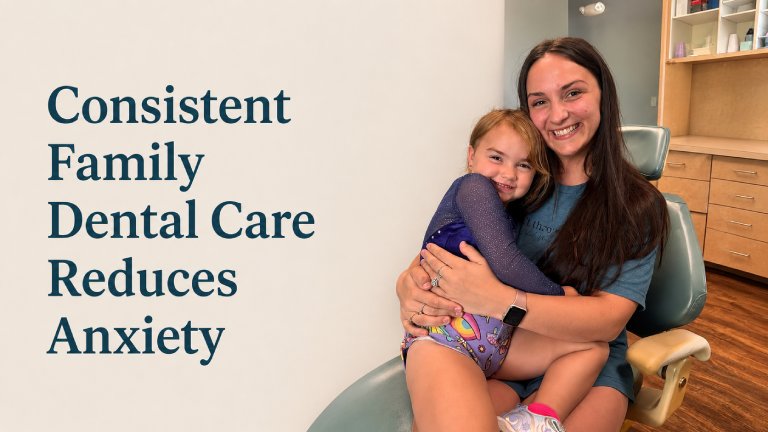
That is the heart of this topic. When you build steady, ongoing care with a family dentist, you usually see less anxiety and fewer surprises over the long run. Consistency creates familiarity. Familiarity builds trust. Trust lowers fear. You are not just getting teeth cleaned. You are shaping how you and your child feel about dental care for years to come.
Why do dental visits trigger so much anxiety in the first place?
Think about what a dental visit looks like through an anxious child’s eyes. New smells. Bright lights. Strangers leaning close with sharp tools. Strange sounds. Little control. It makes sense that many children, and plenty of adults, feel tense or afraid.
Research has shown that dental fear often starts in childhood and can carry into adult life. One study on dental anxiety and behavior points out that a child’s early experiences and the way parents respond to those experiences can strongly shape long-term fear and avoidance of care. If early visits are painful, rushed, or confusing, a child can quickly connect “dentist” with “danger.”
Because of this tension, you might wonder what actually makes it easier. Is it just “being brave,” or is there something more concrete you can do to change the pattern?
How does sticking with one family dentist change the story?
This is where consistency starts to matter. Many pediatric and family dental experts talk about the idea of a “dental home.” The American Academy of Pediatric Dentistry describes a dental home as an ongoing relationship with a dentist, similar to having a regular pediatrician. It is a place that knows your child, tracks history, and offers care that is continuous, coordinated, and family-centered. You can read more about this idea in the AAPD’s policy on the dental home.
So what changes when you build this kind of continuity?
First, your child learns the rhythm of visits. Same waiting room. Same exam chair. Same voices. This predictability alone can lower anxiety. The brain feels safer when it can predict what will happen next.
Second, your dentist and team learn your child’s triggers. Maybe your child hates the sound of the suction but does fine if you explain it first. Maybe they need extra time to sit up between steps. Consistent care means the team remembers those needs and adjusts, instead of discovering them all over again each visit.
Third, trust grows on both sides. You learn to trust that if something is wrong, you will hear about it early, not only when it becomes an emergency. Your child begins to trust that the dentist is not there to hurt them. Over time, this trust can reduce the kind of severe anxiety that leads to skipped appointments and bigger problems later.
Public health experts also highlight this. The Illinois Department of Public Health explains how having a regular dental home makes it more likely that children receive preventive care, have fewer emergency visits, and feel more comfortable with ongoing treatment. You can see their explanation of a dental home for your child for a deeper look.
What happens when care is inconsistent or only “as needed”?
Now picture the opposite pattern. You switch offices often because of schedules, insurance, or bad experiences. You only go when something hurts. Your child never has time to get used to a place, and the visits are usually about fixing pain, not building comfort.
Studies on oral health behavior show that people who avoid regular care often end up needing more urgent, invasive treatment, which is exactly the kind of care that raises anxiety. One analysis of dental utilization patterns found that irregular use of dental services is linked with higher rates of untreated disease and more emergency visits. You can see this kind of research in sources like population studies on dental care use.
Three practical steps to use consistency to reduce dental anxiety
1. Choose one family dentist and commit to a realistic schedule
You do not need the “perfect” office. You need a good fit that you can stick with. Look for a dentist who welcomes children, explains things in simple language, and takes time to listen to your concerns. Ask how they handle anxious kids, and whether they support the idea of a dental home.
Once you choose, commit to regular preventive visits, usually every six months, even if nothing hurts. These low-stress visits help your child see the dentist as a normal part of life instead of a place you only go when something is wrong. This consistency is one of the quiet ways a family dental care routine can reshape anxiety.
2. Build a predictable “visit script” for your child
Anxiety feeds on surprise. Before each cosmetic dentistry Oshawa appointment, walk your child through what will happen in simple steps. For example. “We will sit in the waiting room. Then we go to a big chair that goes up and down. The dentist will count your teeth and clean them. If anything feels weird, you can raise your hand, and we will pause.”
Because you are using the same office and the same dentist, this script can stay mostly the same each time. Over a few visits, your child begins to recognize that what you describe is what actually happens. That match between expectation and reality is powerful for reducing fear.
3. Partner with your dentist to track and celebrate small wins
Share openly with your dentist about what went well and what was hard after each visit. Maybe your child sat in the chair without crying, or they opened their mouth a little longer than last time. Ask the team to notice and praise these small steps too.
When a dentist sees your child regularly, they can measure progress in tiny increments, not just in X-rays. They might shorten early appointments, add a “getting to know you” visit, or use simple behavior techniques that are backed by research on child dental anxiety. Over time, these small adjustments combine into a very different experience for your child, and for you as the parent sitting nearby.
Where do you go from here when anxiety has been around for years?
If dental anxiety has already shaped your family’s story, you are not starting from zero, but you are also not stuck. You can begin with one choice. Find a family dentist you feel you can talk to. Commit to seeing that same team regularly. Give your child and yourself time to build trust in that space.
Consistent care will not erase fear overnight, but it can slowly turn the volume down. With each familiar visit, your child learns that the dentist is a place for care, not just a crisis. That shift is what protects both long-term oral health and long-term peace of mind.
You deserve a calmer, more predictable experience with dental care. Your child deserves to grow up without dreading the dentist. Choosing and staying with a steady family dentist is one of the simplest, most powerful ways to move toward that reality.