You might be feeling a little uneasy about how much of your family’s health history lives in filing cabinets and computer systems you never see. Maybe you have a child with special dental needs, an aging parent with a complex treatment history, or your own memories of “that tooth” that always seems to cause trouble.
Because of this uncertainty, you might worry about gaps. What if your children grow up and move away? What if your parents switch dentists? What if something important gets lost in the shuffle? At the same time, you sense that a good family dentist is not just cleaning teeth. They are quietly building a long, connected story of your family’s oral health.
That is really what this is about. How family dentists preserve oral health records across generations, why it matters more than most people realize, and how you can make sure your family’s information is safe, accessible, and useful for the people you love, now and later.
Why long-term dental records matter more than “just paperwork.”
It might have started with baby teeth and fluoride varnish, then braces, wisdom teeth removal, maybe a crown after a bad fracture, or gum treatment after a stressful season. Each visit left a small trace in your chart. On its own, one X-ray or one note seems minor. Over the years, those little pieces form a pattern that can guide much smarter care.
Now add children or parents to the picture. Your child might inherit your crowded bite or your tendency for weak enamel. Your parent might share a history of gum disease or early tooth loss. Without records that follow the family over time, each new dentist is forced to guess, and guessing is a stressful way to manage anyone’s health.
So where does that leave you? It leaves you standing between past and future, trying to protect your family without becoming a medical archivist. You want to trust that someone is watching the long story, not just the next appointment.
The quiet problems when dental records are not preserved well
There are a few common pain points that families rarely talk about until something goes wrong. Naming them can help you see what is actually at stake.
1. Lost history when families move or change dentists
Imagine your teenager heads to college in another state and sees a new dentist for the first time in years. The new office asks about past orthodontic work, wisdom teeth, and root canals.
When family dental records are preserved across generations, your child’s new dentist can see growth charts, past findings, and previous recommendations. That history can prevent unnecessary treatment, avoid repeated radiation from extra X-rays, and protect your child from painful surprises.
2. Confusion during emergencies or major treatment
Now picture an older parent who breaks a tooth on the weekend. They end up in an emergency clinic that has never seen them before. The dentist there has no way to know about past crowns, root canals, allergies, or bone loss patterns. In a rush, the wrong tooth might be treated, or a medication might be prescribed that conflicts with other care.
When a long-term family dentist has detailed records that are organized and preserved, those records can be shared with specialists or emergency providers. That makes stressful situations safer and smoother, and it reduces the burden on you to “remember everything” in the moment.
3. Legal and ethical obligations you rarely see, but deeply rely on
Behind the scenes, dental records are not just helpful. They are required. The American Dental Association guides record retention and documentation. You can see more about that in the ADA’s resource on dental record retention policies. These guidelines help ensure that your information is not only stored, but stored in a way that protects your privacy and supports quality care if questions arise years later.
How family dentists actually protect and carry records forward
So, how do family dentists keep this long story of your teeth and gums alive from one generation to the next? It usually comes down to a mix of habits, systems, and values.
Thoughtful record keeping from the first visit
A careful family dentist starts building your history from the first appointment. They document medical conditions, medications, allergies, habits like grinding or snoring, and family tendencies like “everyone in our family has weak enamel.” Over time, they add X-rays, photos, periodontal charts, notes about how you respond to treatment, and even small details like anxiety triggers or preferred numbing techniques. All of that becomes part of your family’s story.
Secure digital systems and backups
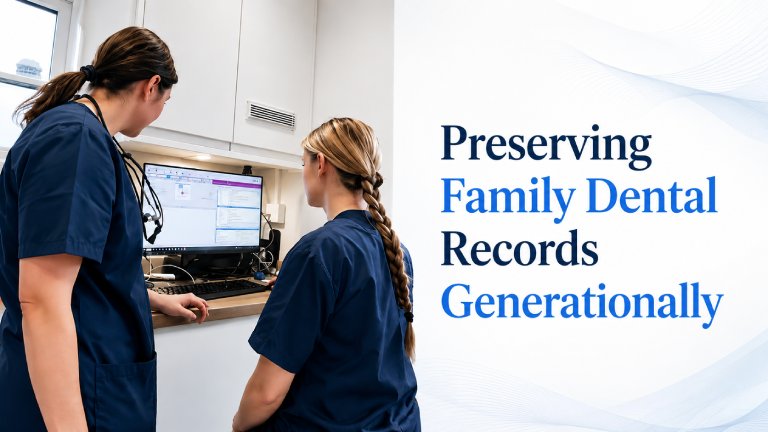
More practices now use electronic health record systems instead of paper charts. When used well, these systems are password-protected, backed up regularly, and designed to be searchable. That means your child’s early X-rays or your parent’s implant notes can be pulled up years later with a few clicks. It also makes it easier to share information with specialists when needed.
Policies for how long records are kept
Every practice has a policy for how long it keeps records. These policies are usually based on state law, insurance rules, and guidance from organizations like the ADA. The goal is to keep records long enough to support ongoing care, protect your rights, and answer questions that may surface later, especially for complex or surgical treatments.
You do not have to memorize those rules. What matters is that your dentist has them, follows them, and is willing to explain them when you ask.
Three practical steps you can take to protect your family’s dental history
Knowing all this, you may be asking what you can do right now, without needing to become an expert in record retention law. With an experienced South Reno dental team, you know your family dentist keeps records, yet you are not quite sure what is stored, how long it is kept, or what happens when years turn into decades. A few simple actions go a long way.
1. Ask clear questions about record policies
You are allowed to ask. The next time you are in the office, you might say, “Can you walk me through how you store and keep our dental records, especially for my kids as they grow up?” A thoughtful practice will be able to explain how long they keep charts, how they back up digital files, and what the process is if your child or you need records sent somewhere else later.
If their answers are vague or defensive, that is useful information. It might mean you want to look for a more organized family dental care provider who treats record preservation as part of patient care, not just paperwork.
2. Keep a simple personal summary for your own reference
You do not need to store every X-ray at home. Still, it can help to keep a short, written summary of key events for each family member. For example, “Braces from age 12 to 15, wisdom teeth removed at 18, root canal on upper right molar in 2022.” You can ask your dentist to confirm or help you build this list. If your child moves away, or your parent sees a new dentist, that one page can make early visits much easier and more accurate.
Think of it as a bridge between you and the professionals. You are not replacing their records. You are simply keeping your own quick map of the big milestones.
3. Plan ahead before major life changes
When you know a change is coming, such as a move, a child going to college, or a parent entering assisted living, give your family dentist a heads up. Ask for copies of recent X-rays, key treatment notes, and a summary letter if needed. Practices that value generational care are usually happy to prepare these. They know continuity matters.
This is especially important if you have a long relationship with your dentist and they have known your family for years. You are not “bothering” them. You are honoring the work they have already done by making sure that the story continues somewhere new.
You do not have to control every detail. You only need to choose a practice that takes record keeping seriously, ask a few thoughtful questions, and stay just aware enough to guide your loved ones when they move or their lives change.