The 2026 FIFA World Cup is well underway. If you’ve been watching, you already know that Brazil carries something with them that no other nation quite replicates. It is not just the trophies, the five World Cup titles, or the roll call of iconic players. It is the way they move. The ease of it. The creativity under pressure.
That quality has a name, and understanding it might just change the way you think about sport altogether.
A Nation That Treats Football as a Philosophy
Brazil has been sending footballers to the World Cups since 1930. In that time, they have developed a style of play that coaches around the world have spent decades trying to deconstruct and reproduce. Few have managed it convincingly.
Part of the reason is that Brazilian football isn’t purely a product of coaching. It grew up in the streets, the beach, and the favelas, where the game was played with improvisation and freedom rather than tactics and structure. The players who emerged from those environments learned to solve problems in real time. To move in unexpected ways, and to use the space around them as a weapon.
That instinct is baked into the culture. And it connects directly to something that might surprise you: Brazilian Jiu-Jitsu.
The Cultural Thread That Links the Pitch and the Mat
Before their squad departed for the 2026 tournament, Brazil’s team plane received what became one of the most shared images of the opening week: a ceremonial water salute at Rio de Janeiro’s international airport, with fire service vehicles arcing streams of water over the aircraft as it prepared to leave. Widely described as a kind of blessing, the gesture captured something real about the way Brazil approaches the World Cup. It isn’t a tournament. It’s a national event with spiritual weight.
That depth of culture runs all the way back to Capoeira, the Afro-Brazilian martial art that blends combat with dance, music, and acrobatics. Capoeira gave Brazilian culture its most fundamental physical principle: the idea that fluid, rhythmic movement is not just expressive but strategic. You sway, you shift, you deceive. You never stand still, because standing still gives your opponent something to read.
From Capoeira, that principle spread into Samba. From Samba, it moved into football. And it gave football players their most celebrated quality: ginga.
Ginga: The Word Every Football Fan Should Know
Ginga (pronounced zheen-ga) translates loosely from Portuguese as “to sway.” In the context of Brazilian football, it describes the continuous movement that allows a player to manipulate space and read opponents before they commit to a direction. Watch footage of Ronaldinho in his prime, and you will see it clearly: the rolling of the hips, the slight drop of the shoulder, the constant low-level repositioning that keeps defenders uncertain.
It looks like flair. It functions like intelligence.
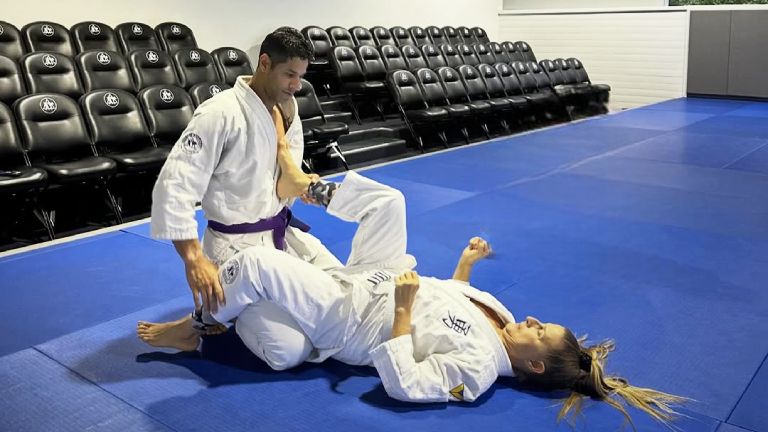
What makes ginga interesting beyond football is that the same underlying logic shows up in Brazilian Jiu-Jitsu. BJJ is a ground-based martial art built on leverage, weight distribution, and spatial control. You succeed by being in the right position, reading how your opponent’s body is about to move, and using that movement to your advantage before they’ve finished making it.
Experienced BJJ practitioners describe rolling (sparring) as something close to a physical conversation. You respond to what you feel rather than what you plan. You adapt constantly. The mat, like the football pitch at its best, rewards fluid intelligence over static aggression.
The Athletes Who Made the Connection Themselves
A number of high-profile footballers have arrived at BJJ not by accident but by design, recognising that the two disciplines share more than they differ.
João Gomes, the Brazilian central midfielder who plays for Wolverhampton Wanderers in the Premier League, began training BJJ at Flamengo’s academy before his professional career took off. He was awarded his blue belt and has spoken about how the training improved his spatial awareness and stamina on the pitch. It’s worth noting that João Gomes is also a defender by trade, a player whose job requires reading bodies in tight spaces and reacting quickly.
Bixente Lizarazu, the French left-back who won the 1998 World Cup with France and six Bundesliga titles with Bayern Munich, took up BJJ in 2008 after retiring from professional football. He trained under French black belt Nicolas Gregoriades and, within 18 months, entered his first competition at the European Championships in Lisbon, where he won the blue belt title in the senior lightweight category. He was 39 years old and had never competed in a martial art before.
Lizarazu later described arriving at the tournament and feeling genuinely intimidated by the other competitors. Then the match started and something clicked. Decades of elite athletic training translated directly onto the mat. The patterns were different, but the underlying qualities- composure, reading of movement, body awareness- were the same.
That’s worth sitting with, particularly if you’ve ever told yourself that martial arts are not for people like you.
Why BJJ Travels So Well
One of the most remarkable things about Brazilian Jiu-Jitsu is how effectively it spreads. The Gracie family, who developed and codified BJJ throughout the 20th century, made it their mission to demonstrate that the art worked regardless of size, age, or athletic background. Their approach wasn’t to train fighters for elite competition. It was to prove that the system itself was robust enough for anyone to use.
That philosophy is what makes modern BJJ academies feel different to other martial arts gyms. There’s no hierarchy of the physically gifted. Progress is gradual and visible. The techniques work not because you’re bigger or stronger, but because the principles are sound.
It’s also why BJJ gyms exist in places you might not expect. Beeston, Nottingham, for example.
Roll Deep BJJ: Authentic Coaching in Beeston
Roll Deep BJJ Academy, based in Beeston on the edge of Nottingham, was founded by Coach Carlos Gomes, a BJJ black belt who built the academy around the same philosophy the Gracies established: world-class technique, taught in a way that’s genuinely accessible to beginners.
The gym sits at Unit 5, Humber Works, Humber Road, NG9 2ET, and has built a reputation not just for the quality of its coaching but for its culture. Members consistently describe an environment that’s welcoming without being soft, and competitive without being hostile. That balance is harder to build than it sounds, and it’s the reason Roll Deep has the member retention it does.
Coach Carlos’ lineage is legitimate. The coaching is consistent. And for anyone in Nottingham with even a passing curiosity about martial arts, it’s one of the better decisions you can make with a Saturday morning.
Five Things BJJ Develops That Most People Don’t Expect
People start BJJ for all kinds of reasons. Fitness. Confidence. Self-defence. Curiosity. What they tend to find surprises them.
- Problem-solving under physical pressure. Every position in BJJ is a problem to be solved. You’re being held down, or you’re holding someone down, and you have a limited set of options to either escape or advance. The discipline develops a particular kind of calm in difficult situations that transfers well beyond the mat.
- Acute body awareness. BJJ practitioners develop an unusually fine-grained understanding of how bodies move and how weight transfers between positions. This is part of why so many elite athletes in other sports find it a useful supplement.
- Ego management. You will be submitted by people smaller, older, and newer to the sport than you. Frequently, at the start. Learning to approach that with curiosity rather than frustration is one of the more valuable things BJJ teaches, and it’s the thing most beginners mention when they reflect on their first few months.
- Genuine fitness. Not gym fitness. The kind that involves full body engagement, cardiovascular demand, and the sort of recovery that comes from actually using your muscles rather than isolating them on machines.
- Community. The cliché is real. BJJ gyms tend to produce unusually tight communities because the training requires you to trust the people around you. You’re vulnerable on the mat, and so is everyone else. That shared vulnerability builds something.
The July Beginner Course: Where to Start
Roll Deep BJJ runs a dedicated beginner course designed specifically for people who’ve never set foot on a mat before. The July 2026 intake starts on 4th July and runs for six weeks, with sessions every Saturday from 9:00 to 10:00 AM.
Here’s what’s included:
- Six structured sessions that build from the absolute basics upwards
- A free uniform (gi) included in the course price, so there’s nothing to buy before you arrive
- Coaching from a BJJ Black Belt with extensive experience working with complete beginners
- A welcoming, ego-free training environment
Course price: £150 for the full six weeks.
You don’t need to be fit to start. You don’t need any martial arts experience. You don’t need to be young, or male, or particularly athletic. The course is designed for people starting from zero, and that’s exactly who it’s for.
If you’ve been watching the World Cup and felt that familiar pull toward sport, movement, and competition, this is a reasonable place to act on it.