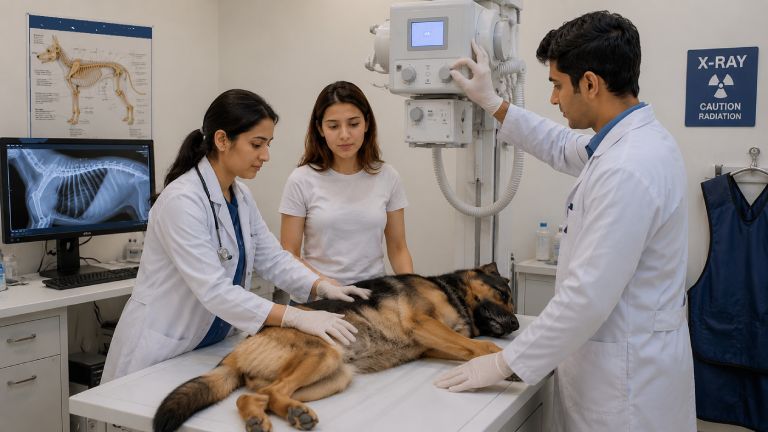
You might be staring at a set of X‑ray images on a screen at a veterinary hospital. You try to make sense of what the vet just said, feeling that mix of fear, confusion, and urgency that comes when an animal you love is hurting. One day your pet is chasing a ball or curling up in your lap, and the next you are talking about MRIs, CT scans, or ultrasound studies as if you were in a human hospital. It can feel overwhelming very quickly.
Because of this tension, you might wonder what exactly a veterinary hospital is doing when it recommends advanced imaging. Is it really necessary? What happens behind the scenes? How do you know you are choosing the right place for something this serious? At the same time, you probably want a simple truth. Modern veterinary hospitals use advanced imaging to see what hands and stethoscopes simply cannot. When used wisely, these tools can shorten the path to a diagnosis, reduce your animal’s pain, and guide treatment in a safer, more targeted way.
This is where the true role of veterinary hospitals in advanced imaging services comes into focus. They are not just “ordering tests.” They are coordinating expertise, technology, and judgment to answer one central question. What is the kindest and most effective way to help this animal right now?
Why does my pet need more than a “regular X‑ray” at a veterinary hospital
It usually starts with something small. A limp that does not go away. A dog who suddenly refuses stairs. Your primary veterinarian examines your pet, runs some basic tests, and then says, “We should do more imaging.” That sentence alone can spike your anxiety. You may hear cost, time, and worst-case scenarios in your head long before you hear the rest of the plan.
The problem is that many conditions are invisible to the naked eye and even to standard radiographs. Internal bleeding, subtle bone fractures, small tumors, spinal cord compression, or complex heart disease can hide behind normal physical exams. As outlined in this overview of diagnostic imaging of animals, different imaging tools show different types of detail. An X‑ray might show bone well but miss soft tissue changes. Ultrasound might show organs clearly but not complex bone structures. Advanced imaging is often the only way to get a clear, three-dimensional understanding of what is wrong.
Because of this, the “agitation” you feel is real. Advanced imaging can be expensive. It may require anesthesia or heavy sedation. It often means traveling to a larger veterinary hospital and trusting people you have never met with your animal’s care. You might worry about your pet being scared, alone, or in pain during procedures. You might also worry that you will get an answer you do not want.
So where does that leave you? It helps to understand what a well-run veterinary hospital is actually doing when it provides advanced veterinary imaging. The team is weighing risk and benefit in detail. They are deciding which test will give the most useful information with the least stress. They are coordinating radiologists, anesthesiologists, and nursing staff. They are setting up protocols so that when your pet arrives, the hospital can move from check-in to imaging to recovery smoothly, with as little waiting and fear as possible.
What exactly do veterinary hospitals do in advanced imaging services?
When people talk about advanced imaging in animal hospitals, they sometimes picture a single machine in a back room. In reality, a modern veterinary hospital functions more like a small diagnostic center with multiple moving parts. There are front desk staff who coordinate referrals and records, nurses and technicians who prepare your pet and monitor them, veterinarians who decide which studies to order, and radiologists who interpret what they see.
Imagine a dog with sudden paralysis in the hind legs. A basic exam tells the vet something is very wrong, but not exactly where. An X‑ray may look almost normal. In a well-equipped hospital, the team may recommend an MRI of the spine. That requires scheduling the MRI suite, planning anesthesia, placing IV lines, monitoring blood pressure, and then sending the images to a radiologist for a detailed report. Within hours, the hospital might identify a slipped disc pressing on the spinal cord and move straight to surgery. Without that imaging, the team would be guessing, and the window for preventing permanent damage could close.
Or think about a cat with chronic vomiting and weight loss. Standard tests show only mild changes. An ultrasound at a veterinary hospital may reveal thickened intestinal walls and enlarged lymph nodes, guiding biopsies that confirm whether the problem is inflammatory bowel disease or cancer. That difference changes everything about treatment and prognosis.
What can you do right now to make imaging decisions feel more manageable
When you feel pressed to make a fast choice, slowing the moment down with a few specific actions can help you regain a sense of control.
1. Ask what the veterinarian is trying to confirm or rule out
Before agreeing to any advanced imaging, ask your vet to explain their reasoning in simple terms. What questions are they hoping the scan will answer? For example, “Is this back pain from a slipped disc or a tumor?” or “Is this mass likely to spread to other organs?”
2. Clarify how the imaging result will change the treatment plan
A powerful question is, “If we do this imaging and it shows X, what would we do. If it shows Y, what would change?” If the treatment would be the same no matter what the images show, you may choose differently than if the results would open or close specific options like surgery, chemotherapy, or specialized pain relief.
3. Prepare your pet and yourself for the hospital visit
Ask the hospital what to expect. Will your pet need to fast? Will they stay for the day or overnight? Can you bring a familiar blanket or toy? Knowing the steps can calm both you and your animal. You can also ask about pain control, monitoring, and how the team reduces stress for anxious or elderly patients. Many hospitals have gentle, well-rehearsed routines for handling nervous animals, and it is reasonable to ask them to describe those to you.
Finding reassurance in the role of veterinary hospitals
Advanced imaging can feel like a big, frightening step, yet it is often the tool that turns guesswork into clear answers and gives you a realistic picture of what your animal is facing. Veterinary hospitals exist to bridge that gap between uncertainty and informed choice. They bring together technology, trained specialists, and compassionate staff so that you are not carrying the weight of these decisions alone.
You are allowed to ask questions. You are allowed to pause and think. You are allowed to say you are scared. A good veterinarian in Gainesville, FL will understand that and meet you where you are. When you work with a hospital that treats your pet as an individual and you as a partner, advanced imaging becomes less about machines and more about finding the kindest path forward.